Back to Blog
Frozen Smoothies: The Grab-and-Go Breakfast Experiment That Actually Works
meal prep
breakfast
smoothies
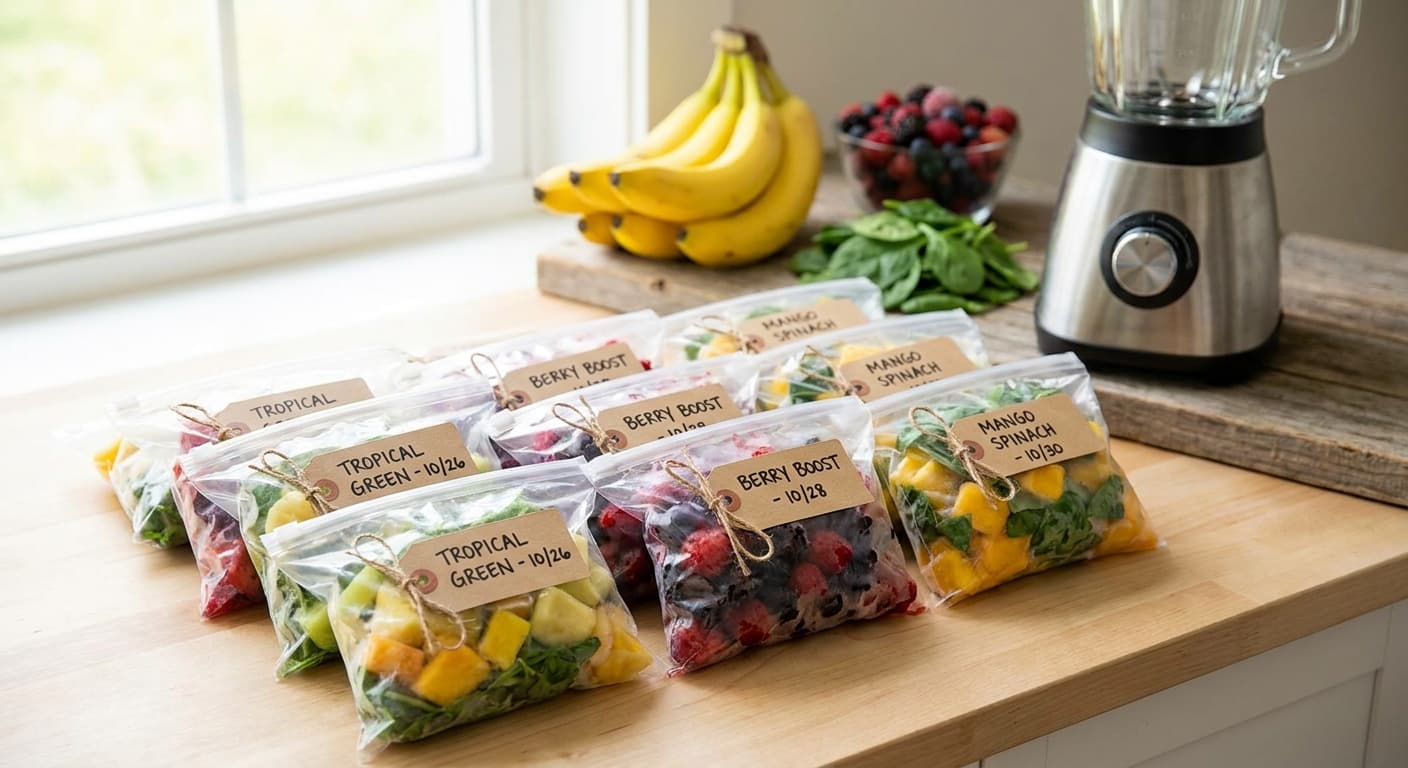
You’ve probably seen the viral “dump all your smoothie ingredients into a freezer bag” hack on social media. The idea sounds almost suspiciously easy: line up tidy little pouches in the freezer, then pour one into a blender in the morning, add liquid, and hit puree.
I’ve tested this at scale—families, busy weeks, and even a few weeks where breakfast was literally whatever didn’t require chewing or thinking before 7 a.m. The verdict? The concept absolutely works—if you treat it like part of your broader meal prep system instead of afterthoughts shoved into a crowded freezer.
Here’s how to build a frozen smoothie kit system that plays nicely with the rest of your meals, keeps your grocery bill reasonable, and actually survives contact with reality.
Traditional “healthy breakfast” recipes assume you have time to chop fruit, wash greens, measure seeds, and clean a blender before 8 a.m. Most of us don’t. Freezer smoothie kits take the decision work and the mess out of the morning. They also:
The key is to treat them like any other meal prep component: plan, batch, label, rotate.
Instead of chasing 10 different recipes, pick 2–3 base formulas and rotate flavors. A reliable structure looks like this:
You’ll add liquid in the morning: milk, plant milk, water, or juice.
Set aside 30–45 minutes once a week (or every other week) to build your kits:
Label with:
If you’re already batching lunches and dinners, your freezer is probably a maze. Create a dedicated “breakfast zone”:
This way, you’re not digging through frozen chicken breasts to find your mango-spinach smoothie at 6:30 a.m.
Let’s do a quick, realistic cost analysis for a basic berry-spinach smoothie kit:
Estimated cost per smoothie: $1.75–$2.75 (without liquid).
Compare that to:
If you buy fruit in bulk, freeze ripe bananas, and use store-brand protein powder, you can push the cost even lower. Over a month of 5 smoothies a week, you’re looking at roughly $35–$55 versus $120–$200+ for takeout.
Think of your week in three layers:
Smoothie kits are the low-effort, high-reward piece of that puzzle. They:
A sample weekly flow might look like this:
You’re not adding a whole new system; you’re extending the one you already have.
Morning: Add 1 cup milk or plant milk, blend until smooth.
Morning: Add 1 cup coconut water or milk, blend.
Morning: Add 1 cup milk, blend until creamy.
If you treat smoothie kits like any other meal prep task—planned, batched, and tracked—they stop being a novelty and become a reliable part of your routine.
The grab-and-go breakfast experiment isn’t just a trend. It’s a small, repeatable system that saves time, money, and mental energy—especially when it’s built into the same framework you’re already using for the rest of your meals.
Get weekly meal planning tips delivered to your inbox.

Quick, stress‑free meal prep tricks to turn busy weeknights into effortless, tasty dinners.

Practical, actionable meal prep tips to get dinner on the table fast. From planning to batch cooking, reclaim your weeknights without the stress.

Tired of chaotic weeknights? Discover practical meal prep strategies to get dinner on the table fast without sacrificing flavor or nutrition.